
Is this commercial not just the slightest bit insulting to women? Firstly, he takes his girlfriend last, almost as an after thought. She is perhaps the least important of his essential accessories? Secondly, is that all she is? An accessory? An object on a par with a computer or a TV? Vodafone might not have meant to be sexist and offensive but they have ceratinly managed it. It may provide an insight into the subconscious of the guys that create ads like this. The CGI are impressive and the concept is clever, but the bottom line leaves a lot to be desired.
Watch the full commercial here:
Tuesday, July 29, 2008
Vodafone's folding girlfriend

Sunday, July 27, 2008
The war on drugs

The latest analysis from the University of Mississippi's Potency Monitoring Project tracked the average amount of THC, the psychoactive ingredient in marijuana, in samples seized by law enforcement agencies from 1975 to 2007. It found that the average amount of THC reached 9.6 per cent last year, compared with 8.75 per cent in 2006".
Source: http://www.smh.com.au/news/science/drug-potency-doubles/2008/06/12/1212863811747.html
The rise in THC levels is hardly surprising. For years police have been targeting marijuana plantations, of both the backyard and commercial variety. This kind of bust has always been a soft target due to the high visibility of crops and improvements in aerial surveillance. It has forced growers to abandon outdoor crops in favour of indoor, hydroponics. Under controlled indoor conditions, marijuana can develop much higher potency. Higher potency levels can contribute to psychological, cognitive and respiratory problems. The problem seems to lie more with the law than with the use of marijuana itself.
Just what is the so called ‘war on drugs’ about? Every year, countless billions of tax payers money is spent on drug enforcement. Countless people end up in prison or worse in some countries for choosing to ingest prohibited substances. Is this expense justified? Why are crimes involving drugs given a higher priority than most others when this is essentially a victimless crime?
Governments and law enforcement agencies might warn that if the prohibited substances in question were legalised social disorder would quickly ensue. They worry they would lose control over large sections of the community, and being in control is always of prime concern.
However, the fact that recreational drugs is illegal does little to discourage their use and somehow society does not come crashing down around our heads. They might argue that if drugs were legal, people would be constantly off their heads and unable to be productive members of society. It is possible to sit down in the gutter with a bottle of scotch but the fact is, most people just don’t. Of course, any drug can be abused, but there have always been a much higher incidence of health problems related to legal drugs like alcohol and tobacco than illegal drugs. Persecuting those who insist on taking drugs has done nothing to solve the problem; in fact it only makes things worse.
Tenaciously targeting soft targets like marijuana does make it difficult to buy, and this increases it’s price. This is very welcome to organised criminals dealing drugs. It makes marijuana sales ever more lucrative and makes buyers with less money much more likely to try cheaper alternatives like heroin. The addictive nature of heroin and narcotics means customers are all the more likely to keep coming back for more; again the dealers profit. The deadly nature of heroin is caused by varying levels of imputy; it might be cut with sugar one week and cement the next. No one knows what they are getting when they buy on the street and addicts frequently die. Another argument often cited is that relaxation of drug laws could make drugs more available to children; but couldn’t age restrictions be applied more easily if the drugs weren’t illegal? As things are there are no restrictions.
Farmers are now being encouraged by many governments to grow non drug producing marijuana. This plant produces the strongest known natural fibre and has an incredibly high yield. It also has other health related benefits and has been used to treat conditions like glaucoma. Perhaps such things are signals that the laws need to be rethought.
The ‘war on drugs’ has been described by some as a modern day version of prohibition. Prohibition failed dramatically and did little more than lead to a rise in organised crime. The war on drugs is little different. Criminals get rich and users suffer. It is more a war on freedom than anything else.
Sunday, July 6, 2008
Roberta's Underbelly

she devil Roberta Williams
Roberta Williams, former wife of crime baron Carl has posed for men's magazine Zoo Weekly in a bikini. Carl and Roberta have practically become household names since featuring as key characters in the hit TV series Underbelly. The shoot has also been covered by A Current Affair. The press has commented that Roberta has sunken to a new low by posing for a tacky magazine. How can this woman who for years benefited from the proceeds of drug dealing and murder be allowed to profit from her notoreity? How deplorable? How sordid? Really?
Has Roberta really sunken to a new low by posing for a few photographs in a bikini? If Underbelly is anything to go by, she was well aware of most of her husband's illegal activities. How else did he come by such a huge fortune when he had no job or other means of income? After initially complaining about her portrayal in the TV series, Roberta is now reaping the benefits of her new found celebrity. Scandal mongers like A Current Affair and Zoo Weekly are very happy to cash in on her fame, and large numbers of consumers are just as happy to lap it up. After living association with drug dealing and murder, posing in a bikini hardly seems 'a new low'. Descriptions of Roberta as 'a tragic figure' seem a bit melodramatic. Her bank account is likely to be anything but tragic. Perhaps we should just be grateful she spared us doing the photo shoot nude.
It's interesting that as soon as a woman comes into the public eye; almost the first thing she's asked to do is take her clothes off for the camera. I doubt Carl will be asked to pose for a photo shoot in his speedos if he ever gets out of prison. Women are always sex objects first and people second (if at all).
Benefiting from the proceeds of crime; sordid, tacky, deplorable: maybe. Surprising? No.
Friday, May 23, 2008
Beowulf's Femme Fatale

Ray Winstone as Beowulf and Angelina Jolie as Grendel's Mother
When I saw this ad on a billboard for the movie 'Beowulf', (directed by Robert Zemeckis 2007) I just had to see it. This film was created with digital animation and the whole thing has the look of a video game. I enjoyed it; no great work of art but it's kind of fun. Ray Winstone must have found it very flattering to have his short, stocky physique transformed into a buff nordic god.
However, the Beowulf story is evidence that the devouring female versus passive victim dichotomy is not confined to classical mythology alone. (This was discussed in an earlier post 'The Rock of Doom') .

Angelina Jolie appears nude as Grendel's mother in Beowulf
In Beowulf, Angelina Jolie plays the monster Grendel's mother. She appears nude except for a thin coating of liquid gold. She has a tail and sexy high heels (I didn't know you could get shoes like that in 6th century Denmark!). She is the archetypal femme fatale; half alluring woman, half devouring beast. She proves to be the nemesis of King Hrothgar (Anthony Hopkins) and then to Beowulf himself. The 'woman as victim' is Queen Wealthow, played by Robin Wright Penn. She endures a loveless marriage with a much older man (King Hrothgar) and then endures marriage to a husband (Beowulf) with a younger and publicly acknowledged mistress Ursula (Alison Lohman).

Norse god: monster slayer Beowulf

The real Ray Winstone: a bit of a monster
Saturday, April 26, 2008
Venus and Olympia
While I was at college, I was set this essay question: "In his early work, Manet was heavily influenced by the old masters. What do you make of this?"
 The image compares Titian's 'Venus of Urbino' to Manet's 'Olympia'. There is obviously a strong similarity. Both depict naked women in a reclining position, and both women are 'courtesans' which is a nice way of saying prostitute. Titian's Venus has long been held by the art establishment as one of the ultimate examples of figure painting and female beauty. In stark contrast, Manet's 'Olympia' created a scandal when it was exhibited at the Paris Salon of 1865. In fact, it ignited a scandal over art and decency that has rarely been paralleled.
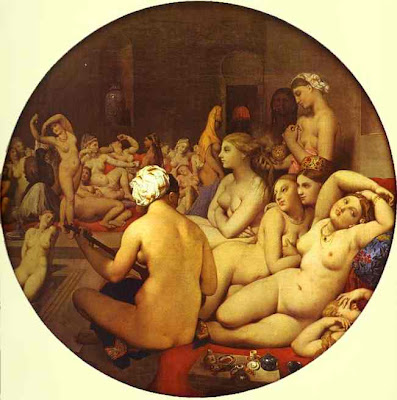
If the two paintings are so similar, why did Olympia cause such a scandal? It's always been considered ok to paint nudes if the context was one of mythology, ancient history, or some exotic, far off place, such as in 'The Turkish Bath' by Ingres.
 Manet's 'Olympia' depicts a contemporary scene, not an exotic or mythological context. Manet's 'Olympia' depicts a prostitute. Rather than allowing the viewer to assume the role of an unseen voyeur, her gaze engages the viewer as she would a customer. As many of the male visitors to the Paris Salon were likely to have visited prostitutes in a similar setting, 'Olympia' was much too close to the bone. While Titian's Venus has a passive, alluring gaze, Olympia's gaze is confronting, even challenging.
 This contrast is further emphasized by the position of the hands in the two pictures. I've always found 'Venus of Urbino' to be rather outrageous in this respect. I mean, what is she doing?! Masturbating is the obvious answer. You can really come to no other conclusion than that she is touching herself; the fingers curl and incline into her genital area. (Just in case you didn't work that out for yourself). It's odd that few, if any art history texts make any reference to this glaring act at all. Perhaps not; it's easier to ignore this detail than to confront it. In any case; how is it possible that Titian's painting was and is regarded as a great academic masterpiece while verging on pornography? It's not so different to a playboy or penthouse image, apart from the fact that is was created by an old master in oils.
 On the other hand (excuse the pun), Olympia's hand has a more defensive posture. It blocks any view of her genital area and seems in some way challenging. It again positions the viewer in the role of customer rather than voyuer, as if to say: 'you don't get this unless you pay for it.' Olympia's whole demeanour is much more reserved. She appears relaxed, yet self possessed. She is much more an individual that Titian's Venus; in no way a passive plaything for a wealthy nobleman but a confident woman offering a service which is as much a part of everyday life now as it was then.
 Another interesting element of Manet's Olympia is the position of the black cat. It's back arched; it's tail upright, it can be seen as a sexual symbol. The position of the tail and hair standing up could be said to be phallic. Who is the cat responding to but the viewer/customer? The cat's pose is defensive and threatening. Furthermore, cats have long been a symbol of femininity, of bad or good luck and were commonly the familiars of witches. This element adds futher tension to the picture; underlining Olympia's inaccessibility. While she will engage in the transaction on her terms alone, a firm barrier protects her. Her inner self cannot be known and is not for sale.
Wednesday, April 23, 2008
The Body Shape Revolution
Cosmo published a section in this month's issue entitled 'The Body Shape Revolution and Where You Fit In'. It featured images of women similar to those in the image below. How nice of Cosmo to define a catalogue of standard body types to help us understand who we are. I personally would be lost without this kind of help. Not having to think for myself makes life a whole lot easier. The body type featured in the image below is not included.

So just what is a true Cosmo girl? The image below seeks to answer the question. 
The Rock of Doom
'The Rock of Doom', by Sir Edward Coley Burne-Jones was painted between 1885 and 1887. This painting is the sixth in Burne-Jones' Perseus Cycle. This picture, like others in the series, draws upon the version of the Perseus legend that appears in William Morris's "The Doom of King Acrisius" from The Earthly Paradise. The picture is in some ways relevant to the issues previously discussed. 
The idea of rescue was quite prevalent in 19th century society. Countless philanthropists established shelters for 'fallen women' to help set them on the path to 'virtue'. The underlying idea is that female sexuality is something that must be controlled. Despite the advances of more recent times women are still characterised as the 'weaker sex'.
This painting also characterises the stereo types of women that appear in Greek mythology. Women seldom if ever have any real personality. They are helpless victims like Andromeda, or are part beast predators like the mermaids, the sirens and the harpies. One only has to look at the classical design of law courts, places of government and other official buildings to realise that the Greek ideal is still alive today. This is not to say that the culture and art of the ancient Greeks (and Burne Jones) is anything but beautiful, but that their gender bias in many ways continues to permeate our lives.